

Ministers set the legal name and 92 councillors for the council replacing Stafford Borough Council, then paused the whole plan on 7 September 2026.
Update, 9 September 2026: this plan is on hold. The government announced a review of local government reorganisation on 7 September and told council leaders to stop implementing the July decisions, including Staffordshire’s. The May 2027 elections will now be ordinary borough elections on existing boundaries. See our report on the pause. The rest of this article records what was decided in July, which is what the review is examining.
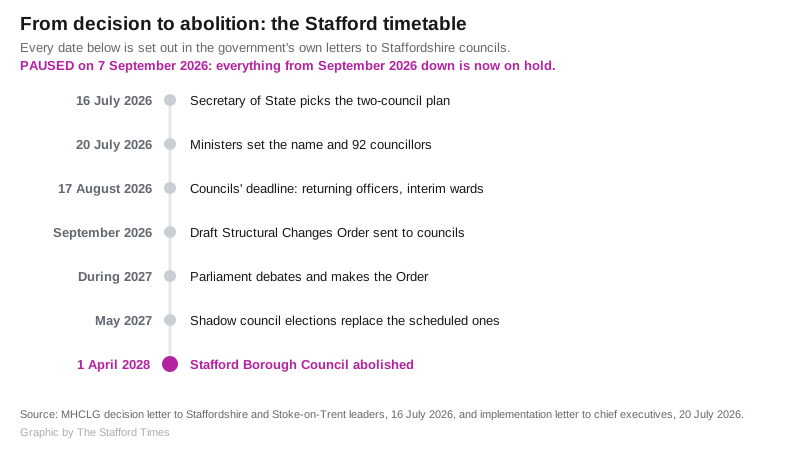
The council that will run Stafford, Stone and the villages from April 2028 now has a legal name, a size and a timetable. It will be called South and Mid Staffordshire, it will have 92 councillors, and the first elections to it fall in May 2027.
The detail is in a letter to the chief executives of all ten Staffordshire and Stoke-on-Trent councils, sent on 20 July. It was written by Beatrice Andrews, co-deputy director for local government reorganisation at the Ministry of Housing, Communities and Local Government. The ministry published it on gov.uk on 4 August. (Implementation letter to Staffordshire and Stoke-on-Trent chief executives, PDF)
The councils asked for “Southern”. They were told no
Stafford Borough Council was one of the three district councils that wrote the winning proposal, alongside East Staffordshire and Cannock Chase, and their plan called the southern authority Southern and Mid-Staffordshire. The government has changed it twice over.
The letter sets out why. Ministers have applied naming rules to every new council being created in this round:
- the word “City” cannot appear in a legal name, because city status is granted by the Monarch rather than by ministers
- the “-ern” suffix cannot be used, which rules out “Southern”
- dashes cannot be included in council names, which rules out “Mid-Staffordshire”
What is left is South and Mid Staffordshire. The name is not quite final. Once the council exists it can rename itself under section 74 of the Local Government Act 1972. That takes a council meeting called for the purpose, and two thirds of the members voting in favour. It can also trade under a different name for branding while keeping the legal one.
Six councils in, 92 councillors out
South and Mid Staffordshire will cover the present areas of Cannock Chase, Lichfield, South Staffordshire, Tamworth, East Staffordshire and Stafford. The other new authority, North Staffordshire, takes in Stoke-on-Trent, Newcastle-under-Lyme and Staffordshire Moorlands and gets 84 councillors.
Staffordshire County Council disappears into the two of them.
Two bodies do the work between now and then:
- a Joint Committee for each new council. For South and Mid Staffordshire it is six district councillors and six county councillors
- a single Implementation Team of officers drawn from all ten councils, led by the head of paid service at Staffordshire County Council. The deputy for the southern area is to be agreed locally from one of the six districts
The government has asked the councils to use their sector adviser, Theresa Grant, as an independent critical friend. It expects the joint committees to be meeting regularly for up to six months before the 2027 elections.
A deadline that has just gone past
The letter set 17 August as the date by which the ten councils had to tell the ministry four things:
- which council’s head of paid service should be returning officer for each new authority
- what the interim ward boundaries should be
- how parish election cycles should line up with the new unitary elections
- which council should receive the transition grant
Ministers also offered one more chance to argue about the names and the councillor numbers by the same date. Any such representation had to be unanimous across every council in a new authority’s area. That deadline passed on Sunday. Neither Stafford Borough Council’s own reorganisation page nor the county’s reorganisation hub had published anything about it when we checked on Wednesday. Whether the six southern councils made a joint case to keep “Southern” is therefore not on the public record.
The warding work matters more than it sounds. The letter asks for interim boundaries built from existing wards, divisions and parishes. Polling districts cannot be used. Those interim wards go into the legislation, and they are what people will vote in next May. A full electoral review by the Local Government Boundary Commission for England comes only afterwards.
The money
The Secretary of State has allocated £900,000 per new unitary for transition costs, so £1.8m across Staffordshire and Stoke-on-Trent, paid as a section 31 grant during 2026/27. A further £150,000 per new unitary is available for leadership capacity in children’s services, adult social care and public health. That comes from a package worth up to £10m nationally, drawn in turn from the government’s existing £63m capacity fund.
The letter is specific about what the money is not for. Short-term consultancy is described as “unlikely to offer good value for money”; it wants spending on service disaggregation, data and cyber resilience, programme management, and equipment and support for the new councillors elected in 2027.
What it means for you
Nothing changes yet. Stafford Borough Council remains responsible for your bins, your council tax bill, planning and licensing, and it is under a legal duty to co-operate with the new authority in the meantime. The same goes for Staffordshire County Council on schools, social care and roads. 1 April 2028 was the abolition date set in July. It is now under review and no new date has been published.
Your next local election is in May 2027, and since the pause it is a borough election again. The July plan replaced any scheduled local elections that year with elections to the new shadow councils, and extended sitting councillors’ terms. The minister’s letter of 7 September says elections in May 2027 “will go ahead to existing council boundaries”.
Expect a brake on big council decisions from 2027. Once the Order is in force, the government expects to issue a direction under section 24 of the Local Government and Public Involvement in Health Act 2007. It would require Stafford Borough Council and the others to get the shadow council’s consent before signing certain contracts or selling certain assets. The stated purpose is to stop predecessor councils committing the new one to deals that undermine the savings.
None of it is law yet. The Structural Changes Order needs Parliamentary approval, and the government expects to share a draft with the councils in September. It then has to clear:
- the Joint Committee on Statutory Instruments
- the Lords Secondary Legislation Scrutiny Committee
- a debate in a committee of each House
- approval motions in both Houses
The government anticipates the Order being made, and coming into force, during 2027.
Our Stafford planning news page covers what the borough council is still deciding in the meantime.
Sources
- Local government reorganisation: implementation letter to Staffordshire and Stoke-on-Trent chief executives (PDF), MHCLG, dated 20 July 2026 and published 4 August 2026, for the names, the councillor numbers, the naming rules, the joint committees, the implementation team, the 17 August deadline, the grant figures and the Parliamentary timetable.
- Local government reorganisation: decision letter to Staffordshire and Stoke-on-Trent council leaders (PDF), from the Secretary of State, Steve Reed, 16 July 2026, for the decision itself, which councils submitted the selected proposal, the reasons, and the May 2027 elections.
- Staffordshire and Stoke-on-Trent: local government reorganisation, GOV.UK, for the full document collection.
- Local government reorganisation in Staffordshire and Stoke-on-Trent, GOV.UK, for the consultation that ran from 5 February to 26 March 2026 and its outcome, published 21 July 2026.
- Devolution and Local Government Reorganisation, Stafford Borough Council, page last updated 4 August 2026, checked on 19 August 2026 for any local response to the letter.
Have your say