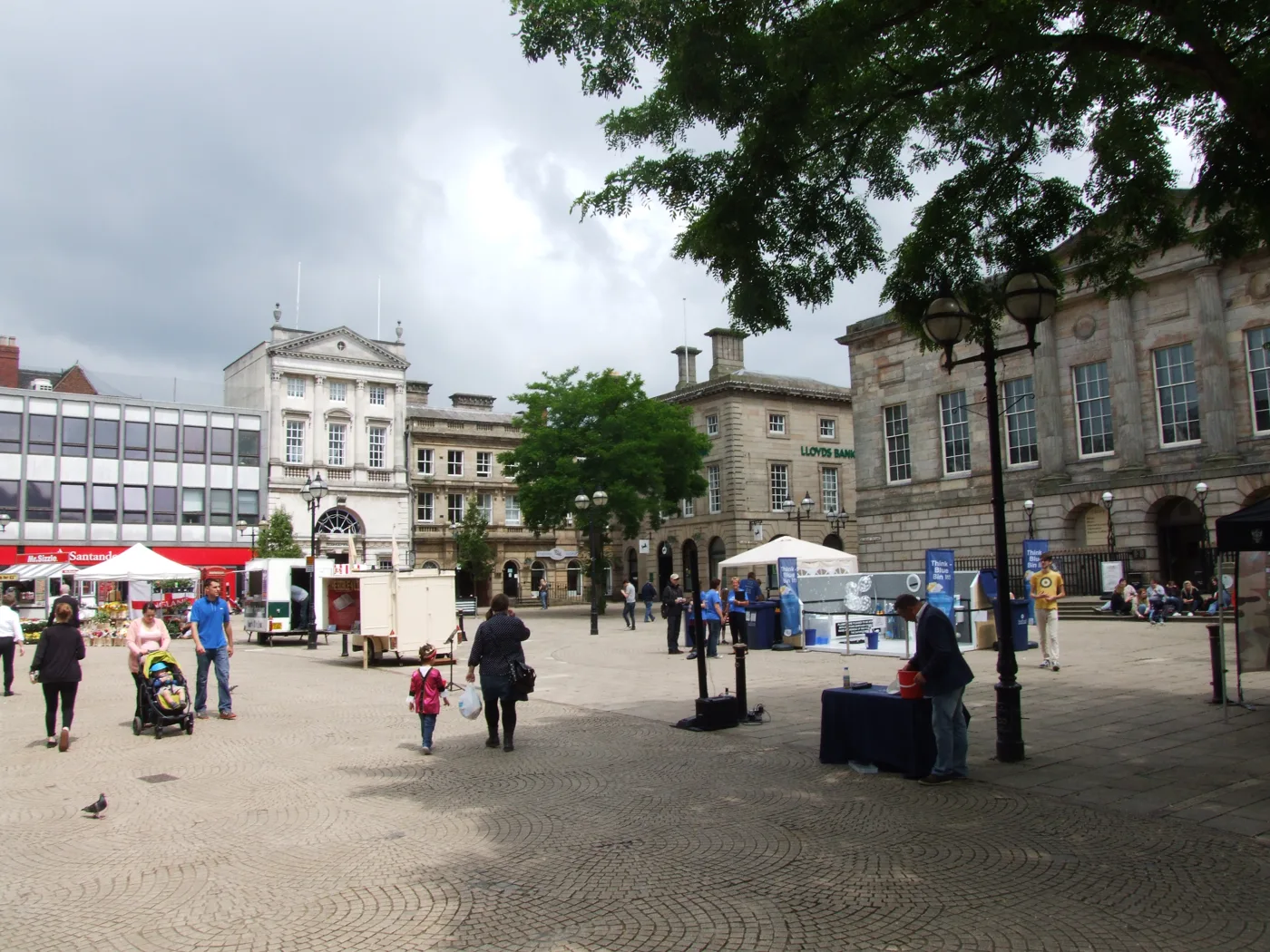

Stafford gets its own town council from April 2027, at £38.44 a year on a Band D home. Nineteen councillors, 11 wards, first elections next May.
Stafford is to get its own town council for the first time. Borough councillors voted on Tuesday 8 September to create it, and the order that brings it into being will be made before 1 December.
The new council will be called Stafford Town Council. It will have 19 councillors across 11 wards, and its first elections will be held in May 2027. It will cost a Band D household £38.44 a year, or about 74p a week.
Stafford has been the only unparished area of the borough. Every other community in it, from Stone to Gnosall to Doxey, already has a parish or town council. That gap is what the council set out to close when it started a Community Governance Review in December 2025.
What was decided
The vote came at a meeting of the full council at County Buildings on Martin Street. The minutes record that the recommendations of the Stafford Town Working Group were carried, and that the Head of Law and Governance was authorised to take every step needed to give them effect. The Leader of the Council, Councillor Aidan Godfrey, called it a historic vote.
The draft establishment order published with the report sets out the mechanics:
- a new parish called Stafford is constituted, with the alternative style of Town
- its council is named Stafford Town Council
- 19 councillors will be elected, across 11 wards
- the order comes into force on 1 April 2027
- the first elections are on the ordinary day of election in 2027, for four-year terms
- the next elections follow in 2031, and every four years after that
The wards use the borough council’s existing boundaries, with one change. Doxey is being left out, so the Castletown part of the Doxey and Castletown borough ward is merged into Rowley, which will be renamed Rowley and Castletown.
Councillors will be split between the wards as follows: Baswich 2, Common 1, Coton 2, Forebridge 1, Highfields and Western Downs 2, Holmcroft 2, Littleworth 2, Manor 2, Penkside 1, Rowley and Castletown 2, and Weeping Cross and Wildwood 2.
Doxey stays out, and its own residents are why
Doxey already has a parish council, and the review asked whether it should be folded into the new town. Across the whole consultation area the answer was close to even: 46.7% in favour of including Doxey, 40.5% against.
Among electors in Doxey itself it was not close at all. 88.8% were against being included, and 7.1% in favour. The working group recommended keeping Doxey separate, and the council agreed.
The consultation
The survey ran from 9 February to 22 March 2026. A letter went to every household in the area under review, and paper copies were available in libraries and at the council’s reception.
1,003 surveys were completed, 923 of them online and 80 on paper. The council excluded anonymous responses, those without an address and those from outside the review area, which left 876 counted in the published figures. On the central question:
- 63.6% were in favour of a town council
- 26.7% were against
- 9.6% were unsure
The report notes that 99.2% of those counted were Stafford residents. It also discloses that AI was used to analyse the themes in the open-ended answers, with an officer checking the output afterwards.
Two other questions were settled by clear majorities. 66.5% wanted the new wards to match the existing borough ward boundaries, and 72.5% wanted them to keep the same names. The number of councillors was the closest call: 42.9% backed 19, with 38% against and 19.1% unsure.
What it will cost
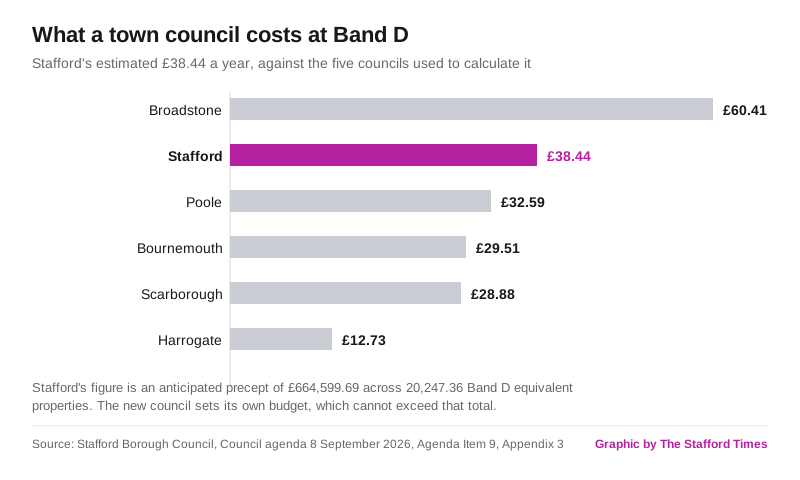
The establishment order has to name an anticipated precept, and it sets that at £664,599.69. Spread across an indicative tax base of 20,247.36 Band D equivalent properties, that produces a Band D charge of £38.44 a year.
That figure is a benchmark, not a budget. The borough council does not set the new council’s spending. Officers arrived at £38.44 by taking the staffing and non-staffing costs of five town councils set up in the last two years, working out what each spent per Band D property, and applying the average to Stafford’s tax base. Those five, and what their own residents pay at Band D, are:
| Town council | Band D charge |
|---|---|
| Broadstone | £60.41 |
| Poole | £32.59 |
| Bournemouth | £29.51 |
| Scarborough | £28.88 |
| Harrogate | £12.73 |
| Stafford (estimated) | £38.44 |
The money buys a small staff rather than services. The report anticipates a qualified full-time clerk, a part-time mayoral support officer and a part-time finance officer, plus rented space, insurance, IT and election costs.
On services and buildings, the report is blunt. There will be “limited initial capacity” to run anything significant, and the only assets legally required to transfer are the allotment sites inside the town area. Nothing else is going across at this stage.
The borough council will collect the precept as billing authority and pass every penny of it on. It has already approved £40,000 for preparatory work, including a temporary town clerk and membership of the Staffordshire Parish Councils Association. The cost of the May 2027 elections will be recharged to the new town council.
The mayor question
One reason this came up now is the mayoralty. Stafford has had a Mayor since Queen Elizabeth II granted the borough a charter in 1974, under section 245 of the Local Government Act 1972.
If the borough council is eventually abolished, that office goes with it. Section 245(6) of the same Act lets a parish council resolve to call itself a Town Council and its chair the Town Mayor. The report expects Stafford Town Council to do exactly that, which would carry the civic year, the ceremonial events and the Freedom of the Borough tradition into the new body.
The alternative, if no town council had been created, was a set of Charter Trustees. The report describes those as a temporary corporate body to hold the ceremonial traditions, while noting that some areas have kept them going for a long time.
Where this sits with the council merger
The report was written on 27 August, before the government paused local government reorganisation in Staffordshire on 7 September. It still describes a Structural Change Order dissolving Stafford Borough Council on 1 April 2028.
That timetable is now under review, and the Leader told the same meeting that work on reorganisation has stopped and that borough elections will go ahead in May 2027, with the term of office still to be determined.
The town council does not depend on any of that. As the report puts it, reorganisation of principal councils has no direct effect on parish councils, so it does not prevent a Stafford Town Council being set up. If anything the pause removes a complication: the same May 2027 poll can now elect both.
There is a second reason the timing matters. Section 62 of the English Devolution and Community Empowerment Act 2026 lets the Secretary of State require councils to put governance arrangements in place for defined neighbourhoods. Where a parish council already exists, the principal council has to engage with it on how that neighbourhood is represented. A town council in place by 2027 is a seat at that table.
What it means for you
If you live in the Stafford town area, three things follow.
You will pay more council tax from April 2027. The estimate is £38.44 a year at Band D, added as a separate precept line on your bill. It is not a replacement for anything you pay now. Check which band your home is in to work out roughly what it means for you: Band A pays two thirds of the Band D figure, Band H twice it.
You will have another election next May. Alongside the borough election you will be voting for 19 town councillors in your ward. The council becomes a legal entity on 1 April 2027, and until the elections its interests will be represented by the existing borough ward members for the area.
If you live in Doxey, nothing changes. Doxey Parish Council continues as it is, and Doxey is not part of the new town area. If you live in Castletown, you move into the Rowley and Castletown town ward.
The new council will set its own detailed budget, which it has to approve by 1 October 2027 and which cannot exceed the anticipated precept. What it chooses to spend that on, and whether it takes on anything beyond the allotments, is the next thing to watch.
Sources
- Stafford Borough Council, minutes of the Council meeting, 8 September 2026 (item C28)
- Stafford Borough Council, Council agenda, 8 September 2026, Agenda Item 9: Community Governance Review for Stafford Town, with the consultation results, draft establishment order, working budget and ward boundaries
- Stafford Borough Council, Councillors pave way for new Town Council for Stafford, 11 September 2026
- Local Government and Public Involvement in Health Act 2007, sections 82 to 100
- Local Government Act 1972, section 245
Have your say