

From 31 October most Stafford planning applications must be decided by officers, not councillors. The council called it a serious loss of democracy.
From 31 October, most planning applications in Stafford will be decided by a council officer and will never reach the Planning Committee. Councillors agreed the change on Tuesday 8 September because the law leaves them no choice, and then voted to put on record that they think it is wrong.
The council’s own resolution, carried on a recorded vote, says the new rules “comprise a serious loss of democracy in removing the right to make views known on many planning matters through local councillors and through a spokesperson at Committee meetings”.
What changes
The change comes from the Town and Country Planning (Discharge of Local Planning Authority Functions) (England) Regulations 2026, made on 15 July and in force from 31 October 2026. They apply to every local planning authority in England.
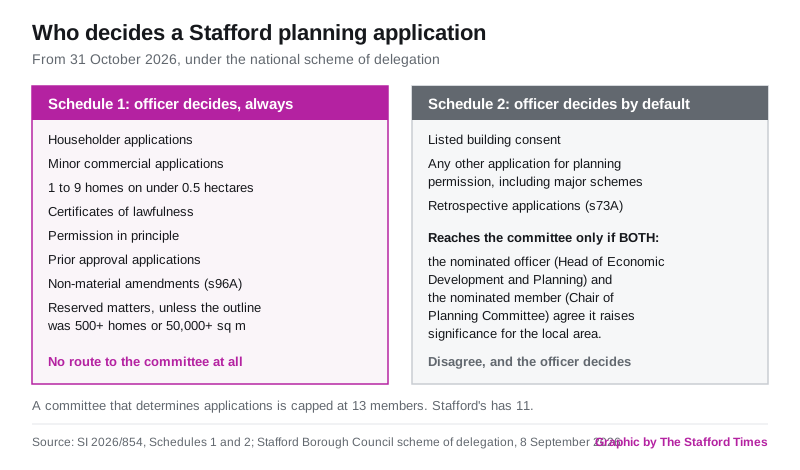
The regulations split applications into two lists.
Schedule 1 must be decided by an officer. There is no discretion and no route to a committee. It covers:
- householder applications, which is most extensions, loft conversions and garden work
- minor commercial applications
- minor residential applications, meaning one to nine homes on a site under 0.5 hectares
- certificates of lawfulness, existing and proposed
- permission in principle
- prior approval applications under permitted development rights
- non-material amendments to a permission under section 96A
- reserved matters on any outline permission smaller than 500 homes or 50,000 square metres
Schedule 2 may go to a committee, but only through a gate. Everything else goes to an officer by default: listed building consent, retrospective applications under section 73A, and any application for planning permission that is not a householder, minor commercial or minor residential one, including major schemes. It reaches the committee only if a nominated member and a nominated officer both agree that it raises an issue of economic, social or environmental significance to the local area, or a significant planning matter under the development plan.
If those two people do not agree, the application is decided by an officer.
Two people now hold the gate in Stafford
The council’s report recommends that the Head of Economic Development and Planning, or another planning officer appointed by them, acts as the nominated officer, and that the Chair of the Planning Committee, or the Vice-Chair in their absence, acts as the nominated member. The committee’s chairman for this municipal year is Councillor B McKeown, with Councillor S N Spencer as vice-chairman.
The report also sets out the government’s guidance for how they should use that power: the presumption “should be that decisions are delegated to officers and only exceptionally referred to committee”.
One further gate exists for applications made by the council itself, or by one of its members or officers, or where any of them has an interest. Those can be referred to committee if the same two people agree, without having to meet the significance test.
The regulations also cap a committee that determines applications at 13 members. Stafford’s Planning Committee has 11, so it does not have to shrink.
The vote
The report was introduced by Councillor A F Reid and seconded by Councillor A Nixon. During the debate Councillor E L Carter, seconded by Councillor D P Rouxel, moved an amendment adding a third recommendation to the report, the one recording the council’s “consternation” at the change. That amendment was carried.
A recorded vote was then taken on the amended motion. The minutes list every name:
- 17 for: J A Barron, R P Cooke, A T A Godfrey, A D Hobbs, J Hood, F D J James, R Kenney, P A Leason, B McKeown, A R McNaughton, D M McNaughton, A Nixon, G P K Pardesi, J P Read, A F Reid, J Thorley, A Thurstance
- 12 against: K M Aspin, A G Cooper, B M Cross, R A James, P W Jones, L Nixon, J M Pert, M Phillips, J T Rose, D P Rouxel, A J Sandiford, S N Spencer
- 3 abstained: E L Carter, A N Pearce, M J Winnington
The amendment on which they were voting was about the wording of the protest, not about whether to comply. The council has no power to refuse the change. Its officers noted only one implication in the report: adopting the mandatory scheme “will reduce the risk of legal challenge against planning decision making”.
What it means for you
If you object to a neighbour’s extension, you have until 31 October to have it heard at committee. After that date a householder application is a Schedule 1 application, and no councillor, parish council or petition can take it to a public meeting. Your objection still has to be considered by the case officer, and it still goes on the file, but the decision is made at a desk.
The same is true of small housing schemes. Anything from one to nine homes on a site under half a hectare is now an officer decision, whatever the local objection to it. That matters more in Stafford than in most places, because the borough can currently show 1.95 years of deliverable housing land against the five years national policy expects, which is exactly the condition in which small speculative sites come forward.
Larger schemes can still be heard, but somebody has to ask. For a Schedule 2 application, the practical step is to put your case to your ward councillor early and ask them to press the chair of the Planning Committee for a referral, framed in the statutory words: economic, social or environmental significance to the local area, or a significant planning matter under the development plan. A request that does not engage those words has no purchase.
The dates to know. Stafford’s Planning Committee meets on 30 September and 28 October under the current rules. Its meeting on 25 November is the first that will run under the new scheme.
The report does not say what happens to applications already queued for the committee when the rules change, and the regulations contain no transitional provision. The Secretary of State has to review how the regulations have worked by 31 October 2028.
Sources
- The Town and Country Planning (Discharge of Local Planning Authority Functions) (England) Regulations 2026, SI 2026/854
- Stafford Borough Council, minutes of the Council meeting, 8 September 2026 (item C29)
- Stafford Borough Council, Council agenda, 8 September 2026, Agenda Item 10: National Scheme of Planning Delegation, and its Appendix 1
- Stafford Borough Council, Planning Committee meeting dates and papers
Have your say