
2,150 people in Stafford borough claimed unemployment benefits in June, 210 more than a year earlier; the 2.5% rate still undercuts the West Midlands' 5.3%.
2,150 people in Stafford borough were claiming unemployment-related benefits in June, according to the Office for National Statistics claimant count, 210 more than in June last year. That is a rise of just under 11 per cent over twelve months, and it lifts the borough’s rate from 2.3 to 2.5 per cent of residents aged 16 to 64. Even so, Stafford remains far below the West Midlands average of 5.3 per cent and Great Britain’s 3.9 per cent. (ONS claimant count, published via Nomis)
The claimant count records people on Jobseeker’s Allowance plus those on Universal Credit who are required to look for work. It is not the full unemployment measure, but it is the only jobs figure published every month at borough level, which makes it the best regular signal of how the local labour market is moving. Figures are rounded to the nearest five.
The 2025 improvement has now been given back
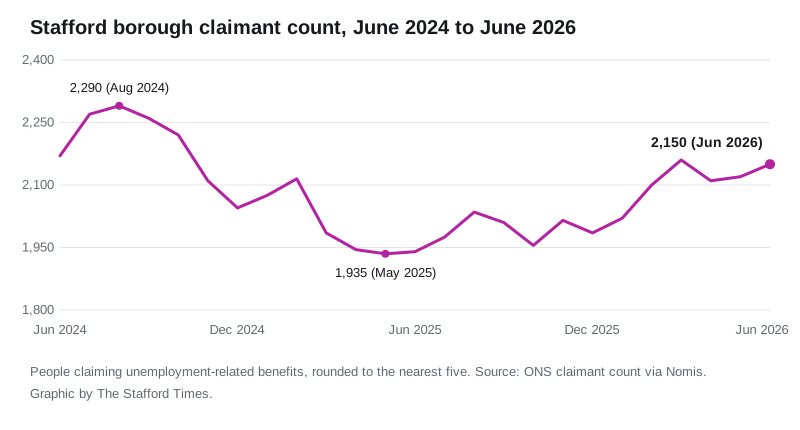
The two-year picture is a round trip. The count peaked at 2,290 in August 2024, fell steadily through the winter and spring to a low of 1,935 in May 2025, then turned. It has been climbing, with wobbles, ever since: 2,020 in January, 2,100 in February, 2,160 in March, and 2,150 in June. The borough has now given back almost all of the ground gained in 2025 and sits just 20 below where it stood two years ago. (Nomis, claimant count for Stafford, retrieved 12 August 2026)
The rise over the past year is spread across every age group, but it is sharpest among the young. 440 of June’s claimants were aged 16 to 24, up from 370 a year earlier, a rise of roughly 19 per cent against 11 per cent for the count as a whole. Claimants aged 25 to 49 rose from 1,120 to 1,200, and the over-50s from 450 to 510.
A five-fold gap between the borough’s wards
Ward figures for June show how uneven the picture is inside the borough. Forebridge has the highest claimant rate at 5.7 per cent, followed by Doxey and Castletown on 4.9, Penkside on 4.8, and Highfields and Western Downs on 4.7 per cent, which at 210 people is the largest single-ward count. All four are Stafford town wards.
At the other end, the Milford and Milwich wards each sit at 1.2 per cent, Baswich at 1.3, and Weeping Cross and Wildwood at 1.4. The rural west is low too, with Eccleshall at 1.6 per cent and Gnosall and Woodseaves the same. In Stone, St Michael’s and Stonefield is on 1.8 per cent and Walton on 2.4. (Nomis, ward-level claimant count, June 2026)
Across Staffordshire’s eight districts, Stafford’s 2.5 per cent is the third lowest, behind Staffordshire Moorlands on 2.1 and Lichfield on 2.2, and ahead of South Staffordshire (2.6), Newcastle-under-Lyme (2.9), Cannock Chase (3.0), Tamworth (3.3) and East Staffordshire (3.4).
What it means for you
Stafford’s 2.5 per cent rate means roughly one working-age resident in 40 is claiming, against about one in 19 across the West Midlands and one in 26 nationally on the same measure, so jobseekers here still face comparatively less competition from other claimants. The rise among under-25s, though, suggests first jobs are harder to land than a year ago. If you have lost work or your hours have been cut, the main route into support is Universal Credit, claimed online; low-income households can also apply for Council Tax Reduction, which cuts the bill rather than paying cash.
The July figures are due from the ONS in mid-September; we will report them when they are published.
Correction, 16 September 2026: this article said the July figures were due in mid-September. They had already been published in August. The ONS has also since revised June’s count for the borough from 2,150 to 2,115. The latest figures, for August 2026, are in our August claimant count report.
Have your say