
2,185 people in Stafford borough claimed jobless benefits in September, up 175 on a year: the most added in Staffordshire, led by under-25s and over-50s.
2,185 people in Stafford borough were claiming unemployment-related benefits in September. That is 175 more than in September 2025, a rise of 8.7%.
No other Staffordshire district added as many claimants over the year, though Lichfield was only five behind. Across England the count rose by 2.6%. The figures are the Office for National Statistics claimant count, published through Nomis on 20 October.
The claimant count covers people on Jobseeker’s Allowance and people on Universal Credit who are required to look for work. It is not the full unemployment rate. It is the only jobs figure published every month for each borough, and all counts are rounded to the nearest five.
The highest for almost two years
The count rose by 40 between August and September. It has now gone up two months running, after four flat months between April and July.
September’s total is the highest since October 2024, when it was 2,220. The peak of the last three years was 2,290 in August 2024, so the borough is not at a record.
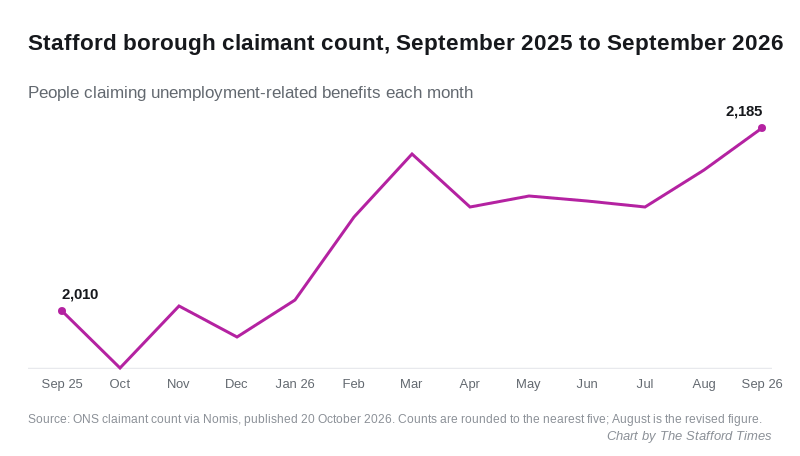
August’s figure has been revised. We reported last month that 2,185 people were claiming in August. The ONS now puts August at 2,145. Provisional claimant counts are routinely revised the following month, and the revision was downwards across Staffordshire.
Under-25s and over-50s again
Most of the rise is at the two ends of working life, as it was last month.
| Age | September 2025 | September 2026 | Change |
|---|---|---|---|
| 16 to 24 | 405 | 480 | +75 (18.5%) |
| 25 to 49 | 1,155 | 1,185 | +30 (2.6%) |
| 50 and over | 450 | 520 | +70 (15.6%) |
| All ages | 2,010 | 2,185 | +175 (8.7%) |
In England, the under-25 count rose by 10.3% and the over-50s by 5.1%. The 25 to 49 group fell slightly, by 0.8%. Stafford’s under-25 count is rising almost twice as fast as England’s, and its over-50 count about three times as fast.
Men account for most of the increase. Male claimants went from 1,100 to 1,235, up 135. Female claimants went from 910 to 950, up 40.
How Stafford compares
The borough’s rate is 2.6% of residents aged 16 to 64, up from 2.4% a year ago. That is still well below England’s 4.1% and the West Midlands’ 5.4%.
| Area | Claimants, Sep 2026 | Change on year | Rate |
|---|---|---|---|
| Stafford | 2,185 | +175 (8.7%) | 2.6% |
| Lichfield | 1,595 | +170 (11.9%) | 2.4% |
| South Staffordshire | 1,775 | +155 (9.6%) | 2.7% |
| Cannock Chase | 2,055 | +145 (7.6%) | 3.2% |
| Tamworth | 1,665 | +90 (5.7%) | 3.3% |
| Staffordshire Moorlands | 1,230 | +50 (4.2%) | 2.2% |
| Newcastle-under-Lyme | 2,380 | +25 (1.1%) | 3.0% |
| East Staffordshire | 2,540 | minus 170 (6.3%) | 3.2% |
| Stoke-on-Trent | 9,030 | minus 300 (3.2%) | 5.3% |
Lichfield and South Staffordshire are rising faster in percentage terms. East Staffordshire and Stoke-on-Trent both fell over the year.
What it means for you
Stafford is still one of the easier places in the region to look for work, with roughly one working-age resident in 38 claiming. But the count has risen for two months in a row, and the rise is concentrated on under-25s and on people over 50.
If you have lost work or had your hours cut, the main route to support is Universal Credit, claimed online. Low-income households can also apply for Council Tax Reduction, which lowers the bill. Our Stafford council tax bands page shows what each band pays.
The October figures are due from the ONS in mid-November.
Sources
- Claimant count, Office for National Statistics via Nomis, published 20 October 2026, for every count, rate, age and sex breakdown and the district comparison. Figures read from the Nomis API on 21 October 2026.
- Our report on the August 2026 claimant count, for the figure first published for August.
Correction, 17 November 2026: the ONS has revised the September 2026 count for Stafford borough from 2,185 to 2,140. The figures above are as first published on 20 October. Our October 2026 report uses the revised figure.
Have your say